Create and download your furnished rental template for free in compliance with all the latest regulatory updates.
Want to go further?

Rental
Our teams manage your next rental: photos, virtual tour, selection of applications, drafting of the ad… You, focus on what really matters.
Drafting of leases
Furnished lease, unfurnished or shared accommodation? Each property has its specificities. We select the appropriate clauses to secure your lease and avoid unpleasant surprises.
Move-in condition report
A concern in your home? Our construction teams intervene quickly to resolve all the small daily issues and preserve the value of your investment.
Exit inventory
Protect your income from the first euro: with our Rent Guarantee, say goodbye to unpaid rents and rent with peace of mind.

The furnished rental lease: specificities and mandatory elements
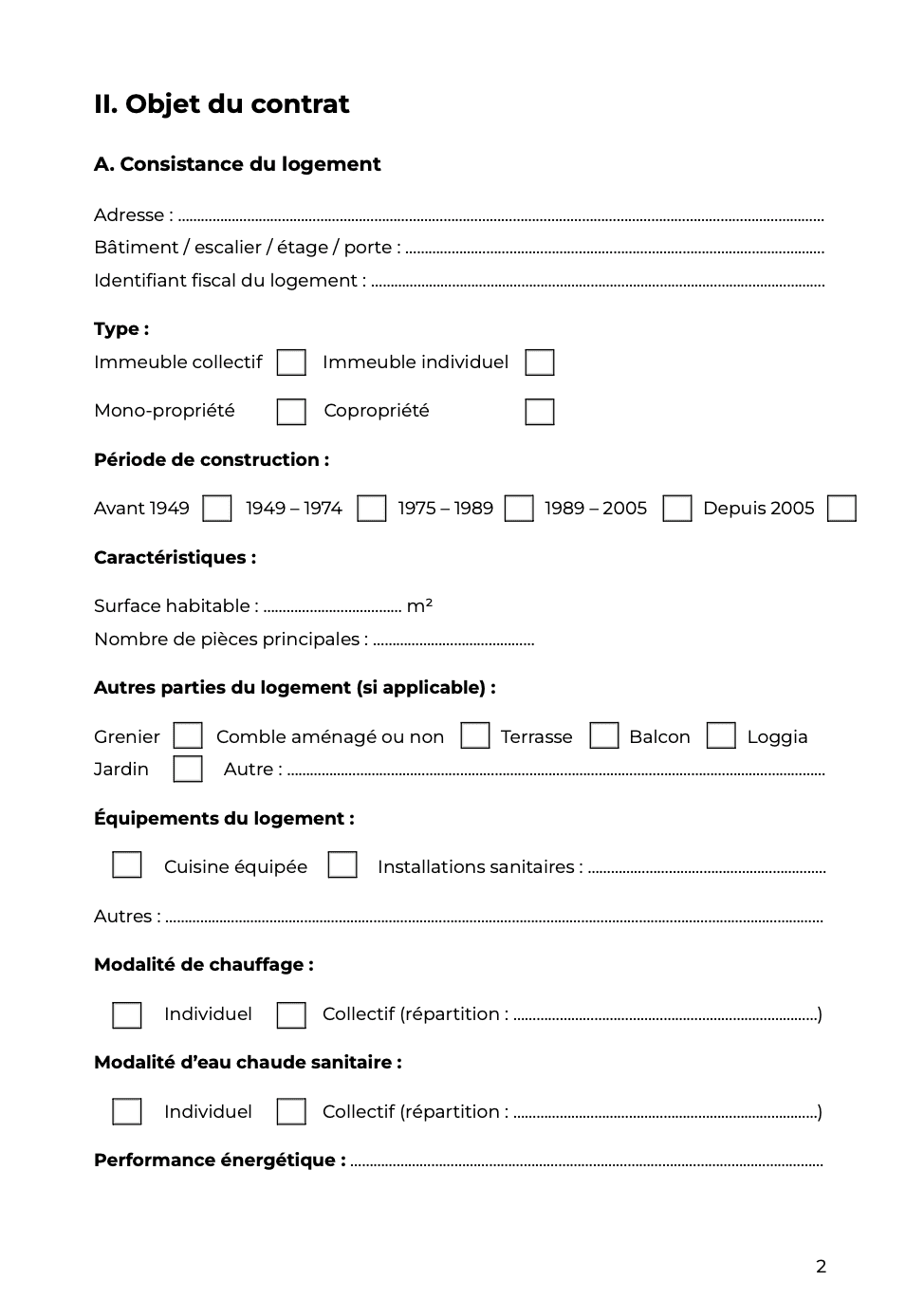
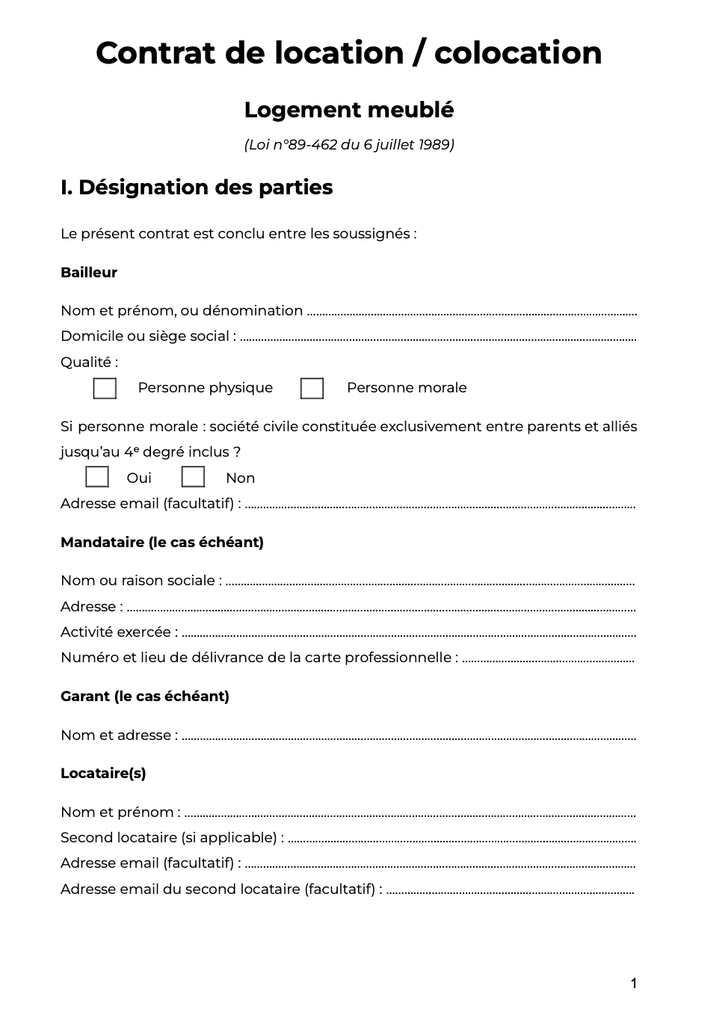
The furnished rental is increasingly appealing to landlord owners for its legal flexibility, its advantageous taxation (LMNP status), and its often superior profitability compared to empty rentals.
But beware: the furnished lease follows a specific regime, defined by the law of July 6, 1989, and has its own obligations and rules.
In this article, discover everything you need to know about the furnished rental lease:
its essential clauses, its duration, the amount of the security deposit, the mandatory inventory, as well as the different types of contracts possible depending on the tenant's profile.
The specifics of the furnished lease
The mandatory clauses
The furnished rental lease must be written and signed by both parties (owner and tenant).
It must mention:
The identity of the parties,
The complete description of the accommodation and its annexes,
The amount of rent, charges, and security deposit,
The duration of the lease,
The conditions for termination,
And the detailed list of equipment provided.
A poorly written or incomplete lease can be reclassified as a empty lease, with significant legal consequences for the owner.
The duration of the lease
The duration of the furnished lease is more flexible than that of an empty lease.
It is generally set at 1 year renewable automatically by tacit renewal.
However, for a student tenant, it can be shortened to 9 months, without automatic renewal at the end of the contract.
Regarding termination:
The tenant can leave the accommodation at any time with a one-month notice.
The landlord can only give notice at the expiration of the lease, with a 3-month notice, and for legitimate reasons: sale of the accommodation, resumption to live there, or the tenant's failure to meet their obligations.
Always clearly specify the terms of termination in the contract to avoid any ambiguity.
Security deposit: amount and return
The security deposit is a financial security for the owner.
In furnished rentals, it can reach up to two months of rent excluding charges, compared to one month only for an empty rental.
This amount must be paid at the time of signing the lease and returned:
within 1 month if no damage is found upon moving out,
within 2 months in case of damages justifying a retention.
Any retention must be justified by estimates or invoices and compared to the entry and exit state of the premises.
Keep a precise follow-up of the property's maintenance (invoices, photos, exchanges) to justify any possible retention and avoid disputes.
Inventory in furnished rental: the mandatory elements
The law imposes a minimum list of furniture for a dwelling to be considered "furnished".
A precise inventory must be attached to the lease and signed by both parties.
The minimum equipment includes in particular:
Bedding with duvet or blanket,
Curtains or shutters,
Cooking plates, oven or microwave,
Refrigerator and freezer,
Table, chairs, dishes, and kitchen utensils,
Lights, shelves, and storage.
Note that the absence of even one of these elements can reclassify the rental as a empty lease, with a different tax and legal regime.
The furnished rental lease, what mandatory mentions are required?
A furnished lease is not merely a simple rental contract: it is a legal document governed by law, whose content is strictly regulated.
These mandatory mentions ensure transparency, legal security, and a good understanding of the rights and duties of both the landlord and the tenant.
Omitting an essential mention can render the lease incomplete or contestable, or even lead to a reclassification of the contract.
Setting rent in tight areas
Since the implementation of rent control, certain cities (Paris, Lille, Lyon, Montpellier, Bordeaux…) are considered tense areas.
In these municipalities, the landlord cannot freely set the rent: they must adhere to a legal ceiling, defined by a prefectural decree.
The contract must specify:
The reference rent (set by the prefecture),
The increased reference rent,
And, if applicable, the rent supplement if the accommodation has exceptional features (view, terrace, high floor, rare amenities…).
Example: in Paris, the increased reference rent for a furnished studio in the 11th arrondissement can be €34/m².
Setting a higher rent without justification exposes the landlord to a request for a decrease from the tenant, or even to administrative sanctions.
Outside of tense areas, the owner remains free to determine their rent, but must ensure it is consistent with local market prices.
Mandatory furniture
One of the pillars of the furnished lease is the presence of complete equipment, ensuring the tenant has immediate and comfortable occupancy of the accommodation.
The law therefore requires the owner to provide a minimum mandatory furniture, the list of which must be attached to the lease.
This list notably includes:
A complete bedding set,
Curtains or shutters
Cooking and refrigeration appliances,
A table and chairs,
Dishes and kitchen utensils,
Lighting and storage spaces.
To avoid any disputes, attach a detailed inventory of the furniture to the contract, specifying the condition of each item.
This inventory, signed by the tenant, will serve as a reference during the exit inventory.
What other types of furnished rental contracts are there?
The classic furnished lease of one year is the most common framework for renting furnished accommodation from a private individual.
But depending on the profile of the tenant and the duration of the rental, other options exist, more flexible and tailored to specific needs.
Knowing these options allows you to optimize the management of your property while respecting the current regulations.
A short-term lease for mobile tenants
The mobility lease is a contract created by the ELAN law (2018) to meet the needs of people temporarily on professional relocation, training, or assignments.
It is intended for mobile tenants, such as students, interns, relocated employees, or freelancers on assignment.
Its main characteristics:
Duration: between 1 and 10 months maximum, non-renewable and non-extendable.
No security deposit is allowed.
Free rent, except in areas subject to rent control.
The accommodation must be furnished according to the legal list of equipment.
This type of lease offers maximum flexibility for the owner, while avoiding the constraints of seasonal rentals or repeated leases.
It particularly attracts investors wishing to profit from a property in a major university or dynamic city (Paris, Lyon, Lille, Nantes…).
A 9-month lease for students
Specifically designed for students, this contract follows most of the rules of the classic furnished lease, with one exception:
it is signed for 9 non-renewable months and without tacit renewal.
The essential points:
The accommodation must be fully furnished.
The rent and charges follow the same rules as for a standard furnished lease.
The tenant can leave the accommodation at any time, with a one-month notice.
This type of lease is particularly suitable for investors targeting university cities.
It allows for quick annual rentals, with predictable turnover and a rental yield often higher than unfurnished rentals.
Between two tenants, take advantage of the summer period to refresh the accommodation and adjust the rent in accordance with the market and regulations.
The civil lease
The civil lease (or common law lease) applies to furnished rentals that do not constitute the tenant's principal residence. This type of lease is widely used by landlords in tight rental markets, as you are not subject to rent control.
It covers, for example:
a secondary rental,
a temporary rental,
or a service accommodation.
This contract is more flexible than the classic housing lease:
The duration, rent, and termination conditions are freely set between the parties.
It is not subject to the law of July 6, 1989, but to the Civil Code.
However, this freedom also implies less protection for the tenant, which requires a clear and rigorous drafting to avoid disputes.
This type of lease is ideal for a short or medium-term rental (a few months), particularly for professionals on assignment or secondary residences.