Create and download your free 2025 inventory template compliant with the Alur Law, from studio to T5.



Everything you need to know about the inventory check-in and check-out
The inventory at the beginning and end of a lease is a crucial step in any rental, whether it is an empty or furnished accommodation. This official document allows for assessing the condition of the property upon the tenant's arrival and departure, thus avoiding disputes and misunderstandings.
Well executed, it serves as legal proof in the event of damage or disagreement regarding the return of the security deposit.
In this article, you will discover when and how to conduct an inventory, the elements to include, as well as best practices to protect both the landlord and the tenant.
When to conduct a property inventory?
The inventory at the start: the first day of the rental
The inventory at the start is conducted during the handing over of the keys, often on the day the lease is signed or at the beginning of the rental. It must be carried out in the presence of the tenant and the landlord (or their representative), so that both parties can examine the condition of the accommodation and its equipment together. Both parties must also record the individual meters.
On that day, the observed condition of the accommodation is the one for which the tenant will be held responsible in case of changes. Conversely, the landlord cannot deduct costs from the security deposit for prior conditions or damages.
For furnished rentals, this document is even more crucial as it serves as an accurate inventory of the items present. The document must be dated and signed by both parties, and each party must keep a copy.
Practical advice: accurately record all details (tasks, scratches, missing bulbs, etc.). In case of uncertainty, add dated photos to support your observations.
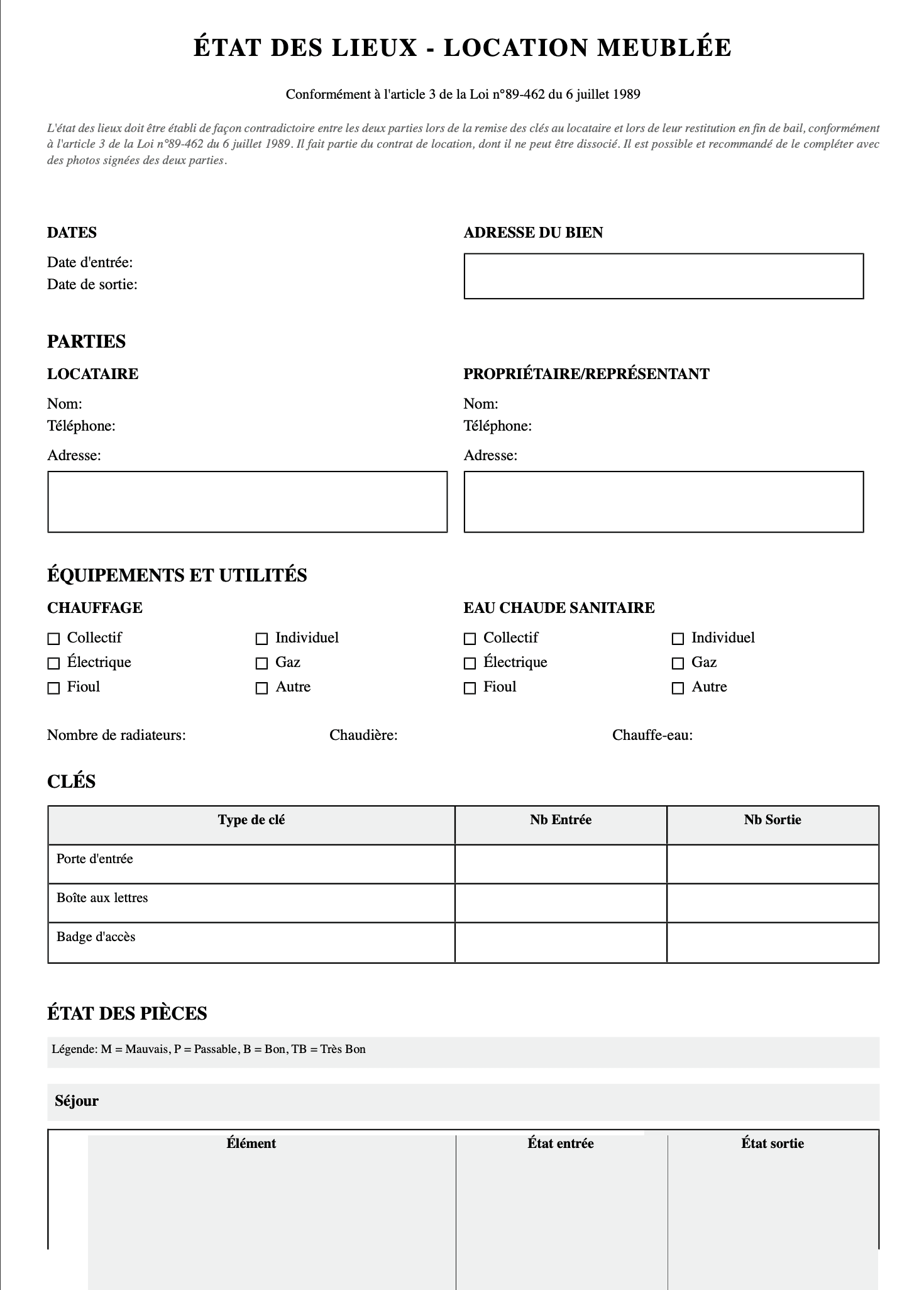
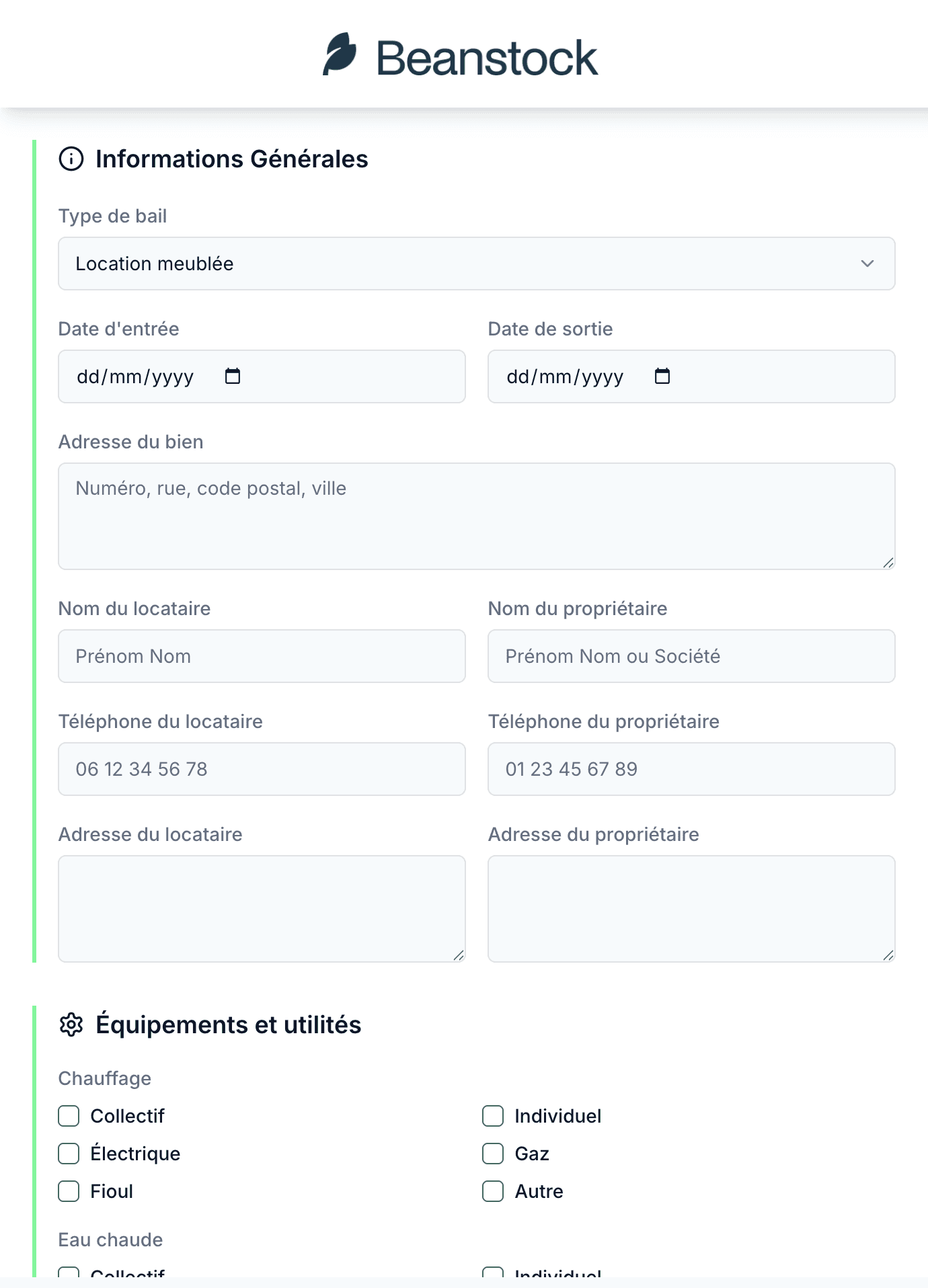
We offer a template for the inventory that landlords and tenants can use.
The inventory at the end: the last day of the rental
The inventory at the end is performed during the return of the keys at the end of the lease. It serves to compare the current condition of the accommodation with that at the time of entry. Any damage not attributable to normal wear and tear may result in a deduction from the security deposit. It is imperative that this inventory is conducted simultaneously with the exit, that is, when the keys are handed over.
The accommodation must be found in a condition equivalent to that at entry; otherwise, the landlord has the right to deduct repair costs from the tenant's security deposit. The landlord is not obliged to provide invoices if requested, as they may include, for example, the cost of new paint to account for wear, even if this is not carried out.
However, the amounts withheld must remain reasonable. It is up to the landlord to be fair, otherwise the deduction could be contested. Both parties must also record the individual meters.
Good to know: if the tenant refuses to participate or sign the inventory, the landlord can hire a bailiff. The costs will be shared between the two parties according to an official scale.

What should an inventory report indicate?
Mandatory Documents
A compliant inventory must include various precise and standardized essential information. Among the mandatory mentions are: the complete address of the dwelling as well as the contact details of both parties, the nature of the inventory (entry or exit), the date it was established, the readings of the meters (water, gas, electricity), a detailed description of each room (floors, walls, ceilings, carpentry, heating systems, sanitary facilities, appliances, etc.), and the signatures of the owner and the tenant.
It is crucial to meticulously detail the condition of each element of the dwelling in the entry and exit inventory, attaching supporting photos for clarity.
Advice: use our model in accordance with the ALUR law to not forget anything. Some platforms offer easy-to-fill and archive digital templates.
Comparison at Exit
The fundamental interest of the inventory lies in the comparison between the initial state and the final state of the dwelling. The observed damages must be described objectively and precisely (e.g.: “peeled paint on 1 m² above the radiator”).
Repairs due to normal wear and tear cannot be charged to the tenant. For instance, the wear of a mattress is considered normal wear, while significant stains may incur additional repair costs, forcing the owner to purchase a new one. It is advisable to be accompanied by professionals to ensure the objectivity of the assessment, such as a real estate agency.
A depreciation schedule can be attached to the lease to specify what falls under natural wear or deterioration.
A well-done inventory: protection for owners and tenants
The inventory is much more than just a simple administrative formality.
For the owner, it serves as evidence in case of disputes and guarantees the protection of their real estate assets.
For the tenant, it ensures that no unjustified deductions will be made from the security deposit. A well-done inventory is essential for both parties.
The security deposit: a direct link to the inventory
The security deposit is directly related to the quality of the inventory.
When a tenant leaves the accommodation, the landlord must compare the entry condition and the exit condition to verify if any damages have been observed.
If damages exceed normal wear and tear, the owner may retain all or part of the security deposit to cover repairs.
On the other hand, if the accommodation is returned in the same condition as when entered, the deposit must be fully refunded within 30 days following the return of the keys (or 60 days in the case of justified damages).
Accompany each remark with dated photos and keep the invoices for repairs or maintenance. They will serve as strong evidence in case of disputes.
A detailed inventory thus protects the owner against financial losses, while ensuring the tenant an equitable return of their security deposit.
The depreciation grid: a tool for fairness and transparency
One of the main points of tension during an exit inventory lies in the distinction between normal wear and tear and damage attributable to the tenant.
This is where the depreciation grid comes into play, a non-mandatory but highly recommended document.
The depreciation grid allows for determining the average lifespan of the elements of the accommodation (paint, floors, equipment, appliances, etc.) and the division of responsibility between the landlord and tenant in the event of deterioration.
Example: a carpet has an average lifespan of 8 years. If it shows natural wear after 5 years, no retention can be applied to the tenant. However, a significant stain or burn may justify a partial retention according to the grid.
Some grids come from collective agreements (such as those from the Federation of HLM offices or the Social Union for Habitat). They can be attached to the lease to serve as a common reference in cases of disagreement.
Thanks to this objective approach, the depreciation grid becomes a trustworthy tool that secures the rental relationship and avoids subjective interpretations.