
What you need to know before renting or selling your real estate
Since July 1, 2021, a new Energy Performance Certificate (DPE) has emerged: a small revolution for the French real estate sector and particularly for rental investment!
Objective: Zero energy sieve!
This new energy performance certificate (DPE) comes directly from the energy-climate law adopted on November 8, 2019, which aims to limit greenhouse gas emissions.
The law encourages the use of more renewable energies, the establishment of new bodies for climate policy, better regulation of the energy sector, and finally, tackling "thermal sieves" (classified as F or G).
Thermal sieves are estimated to be responsible for 20% of greenhouse gas emissions (GHG) in France.
The goal is to encourage owners of energy-intensive housing to undertake work to reduce their energy consumption and end the still too numerous thermal sieves in the centers of large cities (Paris, Lyon, Bordeaux, or Marseille, for example).
As part of the climate and resilience law, thermal sieves will need to be brought up to standard or they will no longer be allowed to be rented out.
The DPE, an essential document in real estate transactions
The DPE is an essential document for the sale or rental:
In the context of a sale, it is part of the technical diagnosis attached to the preliminary contract and the authentic deed.
In the context of a rental, it must be provided to the tenant upon their entry into the premises.
It informs the buyer or tenant of the energy consumption of the housing and the amount of greenhouse gases emitted by it.
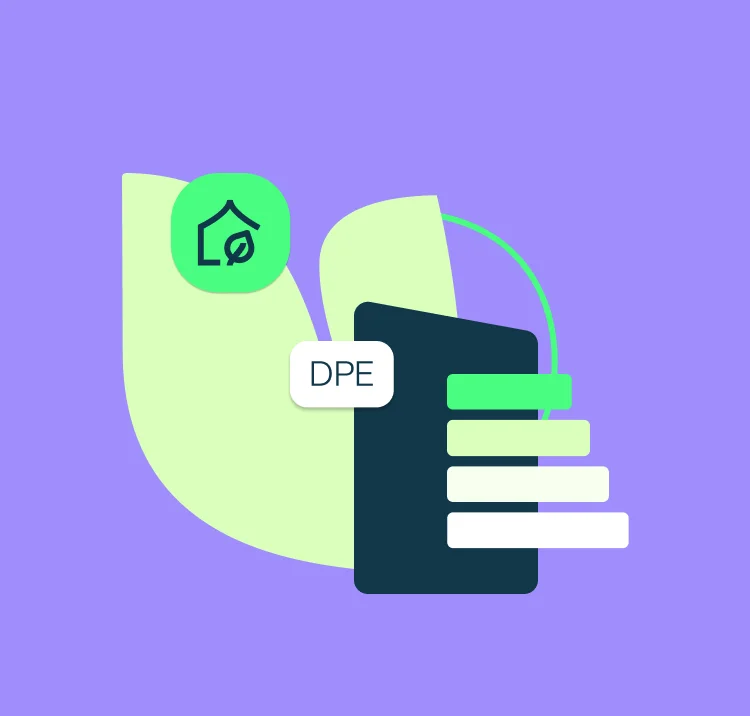
Presented in the form of an energy label and rated from A to G, the diagnosis must be carried out by a certified professional. It also includes a section informing about the necessary work to improve the housing's rating.
The diagnostician and the owner are responsible towards the buyer or tenant: at the slightest doubt, a new diagnosis can be carried out and financial compensation demanded if the result differs.
How much does it cost and who pays?
According to ADEME (Agency for Ecological Transition), the DPE costs between €100 and €250 depending on the provider, the heating installation present, the location, and the surface area of the property.
It is the responsibility of the owner, who can include it as an expense in their income tax declaration.
What changes:
A more readable document
Since January 2022, three elements are mandatory on real estate listings:
The label indicating the energy class of the accommodation,
The climate / GHG label
An estimate of the annual energy bill.
These are not the only ones! Here are other elements to mention
The amount of bills
The detailed thermal losses
The state of thermal insulation of the accommodation
The state of the heating and ventilation system
The presence or absence of a chimney
The level of summer comfort of the accommodation
Recommendations for work and a cost estimate to improve the rating
The new DPE is still valid for 10 years.
A new calculation method and new universal criteria
The calculation method for the DPE has been completely redesigned to be unified and applicable to all accommodations. Thus, it is based on criteria such as:
The characteristics of the accommodation
Insulation
The windows and the type of glazing
The heating system in use
The consideration of weather and equipment installed in the accommodation.
The document is more reliable and has a real legal value. Previously done for informational purposes and calculated rather artisanally, the DPE is now fully enforceable, just like other real estate diagnostics (lead, asbestos, or electricity).
How are labels A to G determined?
Two factors come into play
the estimated primary energy consumption in kWh/m2/year
the greenhouse gas emissions, estimated in kgCO2/m2/year
Specifically: it’s the end of blank energy performance certificates! Nevertheless, the blank certificates issued between 2017 and 2018 are still tolerated until the end of 2024.
Good to know about the validity of old energy performance certificates: Old certificates remain valid until the end of 2024, if they were carried out between January 2018 and December 2021.
The calendar to remember
01/07/2021: Entry into force of the enforceable DPE for all housing (Elan Law 2018)
01/01/2022: Real estate listings must necessarily include the energy label, the climate label, and an estimate of the energy bill (Energy Climate Law 2019)
01/01/2023: It will be prohibited to rent housing with an energy consumption higher than 450 kWh/m2 ([Decency decree, 2019](Decree No. 2021-19 of January 11, 2021))
01/01/2025: phasing out old DPEs and prohibition on renting housing rated G.
01/01/2028: formal prohibition on renting all housing classified as F or G.
In conclusion
The DPE has become more comprehensive, more readable, and enforceable. The calculation particularly considers the location of the housing, and it is no longer possible to have blank DPEs. It is strongly recommended to carry out a DPE as part of a sales project. At Beanstock, we take this new regulation into account in order to provide work estimates that are in line with it! Whether it is economic, ecological, or ethical (for the well-being of your tenants), we all have a good reason to bring energy-wasting properties up to standard!